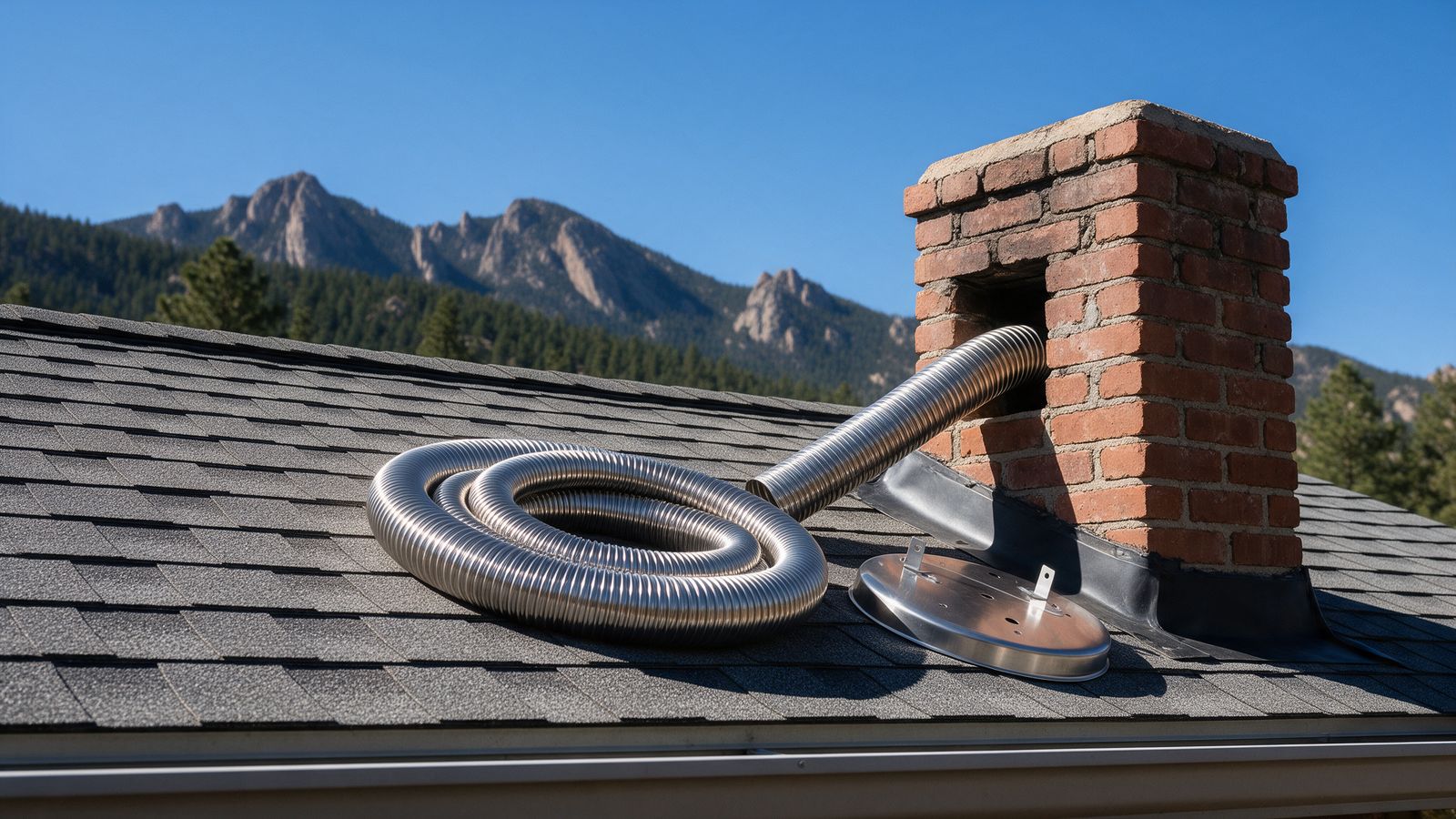
The least expensive suitable chimney lining solution is the one that meets the appliance's requirements and corrects the documented defect without unnecessary work. There is no universal cheapest material that works for every fireplace, stove or heating appliance. Fuel, venting category, flue dimensions, existing damage and installation access determine which options are technically appropriate before price can be compared.
For a Parker homeowner, the strongest way to control cost is to define the problem and compare equivalent scopes. A low quote that omits required insulation, connecting parts or permit work is not necessarily a saving. A higher quote may also include repairs unrelated to relining, so separate those items before deciding.
Confirm why a liner is being recommended
A liner carries combustion products through the chimney and helps protect surrounding construction from heat and gases. Relining may be appropriate when the existing passage is damaged, absent, unsuitable for the appliance or incorrectly sized. The recommendation should identify which condition applies and what evidence supports it.[1]
Ask for inspection images, measurements and the appliance information used in the assessment. A description such as old chimney is not enough. Age can inform the investigation, but it does not identify the exact defect or prove that every available repair method is appropriate.
If the concern is a suspected chimney fire, keep the system unused until evaluated. Document relevant damage before cleaning or removal changes the evidence. A lining proposal should reflect the complete post event findings rather than assume a liner corrects every possible structural or clearance problem.[2]
Start with the appliance rather than the material
An open masonry fireplace, wood stove, pellet appliance and gas appliance do not create identical exhaust conditions. Temperature, moisture, pressure and condensate characteristics affect liner selection. A material approved for one application may be wrong for another. Request the exact product listing and manufacturer instructions.
For listed residential chimney lining systems, UL 1777 is an important standard within its defined scope.[3] A reference to stainless steel alone does not explain the full installation. Alloy, construction, insulation, connectors and termination details all need to suit the product and application.
Do not choose diameter only because a smaller liner is easier to install. Sizing must follow the appliance and applicable venting requirements. An undersized passage can restrict flow, while an unsuitable oversized passage can cool exhaust and affect performance. The sizing basis belongs in the proposal.
“Compare the complete approved installation before comparing the liner price.”
Understand the options that may be considered
| Option | Potential role | Important limitation |
|---|---|---|
| Localized tile repair | A defined accessible defect | Does not address widespread deterioration |
| Listed metal liner | Compatible appliance and existing route | Needs correct sizing and installation details |
| Cast or proprietary repair system | Applications permitted by that system | Substrate and approval conditions control |
| Broader reconstruction | Structural or geometry failure | A liner cannot restore every surrounding defect |
These are categories for discussion, not a menu every chimney qualifies for. Ask the contractor to explain which choices were ruled out and why. A useful estimate links the chosen option to the inspection findings.
Identify the costs that change between homes
Height and access affect labor. A steep roof, difficult staging area or multiple stories can require more protection and equipment. Internal offsets can complicate installation even when the chimney looks straight outside. Measurements and route assessment are better cost inputs than the house's age alone.
The existing liner also matters. Some installations can retain old tile around a new system; others may require removal or another approved approach. Tile removal changes debris, dust control, labor and the risk to surrounding work. The estimate should state whether it is included rather than discovering the issue after the contract is signed.
Connections at the bottom and top can add significant scope. The appliance connector, cleanout, support, top plate, cap and weather details need attention. A price for a length of liner does not describe a functioning venting system from appliance to termination.
Treat insulation as a requirement question
Insulation may be required by the liner listing, existing clearances or the system design. It can also influence exhaust temperature and condensation behavior. The correct question is which insulation arrangement the installation requires, not whether insulation can be deleted to reach a lower price.
Ask the contractor to name the insulation product, required thickness and installation method. If a proposal omits it, request the documented basis. Do not assume that a chimney surrounded by brick automatically has the clearances needed for every uninsulated installation.
This is also a reason to investigate the available space early. A product that fits without insulation may not fit when installed as required. Discovering that after materials arrive can change the plan, schedule and cost.
Separate necessary work from optional improvements
A new cap, crown repair or masonry work may be needed alongside relining, but each should have an identified reason. Ask which items are necessary for the liner installation, which address independent defects and which are optional appearance improvements. That separation helps prioritize spending without removing essential safety work.
If the exterior chimney is unstable, relining may not be the first task. Loose masonry, major movement or compromised support may require repair or structural evaluation. A liner installed inside a failing enclosure can leave the homeowner paying for another disruption later.
Likewise, relining does not necessarily solve every smoke complaint. House pressure, fireplace opening geometry and appliance operation may still matter. Request an explanation of the expected improvement and the conditions that remain outside the proposed work.
Compare proposals in six steps
- Confirm that each estimate uses the same appliance and inspection findings.
- Compare product name, listing, material and proposed dimensions.
- Check insulation, tile removal, connectors and termination components.
- Identify access, protection, disposal and cleanup provisions.
- Confirm permits, inspections and responsibility for related trades.
- Compare warranty terms, exclusions and final documentation.
Parker publishes building codes and permit information for work within its jurisdiction.[4] Confirm requirements for the actual property and project. Do not accept a blanket assertion that every liner either always needs or never needs the same permit process.
Reduce cost through preparation rather than shortcuts
Provide appliance manuals, prior reports and clear photographs before the assessment. Explain future plans, including a possible appliance replacement. Installing a liner for equipment that will soon be changed can create avoidable expense if the next appliance requires a different venting arrangement.
Coordinate necessary roof access or masonry work when practical. Shared staging may reduce repeated setup, but only when the trades and materials can be sequenced correctly. Ask for the savings to be explained rather than assuming a package price is automatically better.
Keep the homeowner's role realistic. Clearing a path and moving fragile items can help preparation. Rooftop work, liner sizing and concealed demolition should not become informal do it yourself tasks merely because a quote feels high. Mistakes can damage the appliance, chimney or finished interior.
Review warranty language separately from expected service life. Determine which organization supplies the warranty, whether registration is required and what maintenance records must be retained. Material coverage may differ from labor coverage, and exclusions can affect the cost of a later visit. Ask how a problem would be reported and who would inspect it. These details do not guarantee a particular lifespan, but they clarify the agreement. Keep the final invoice, product identification and installation photographs together so future service providers can evaluate the installed system without having to infer its components from appearance alone.
Confirm whether access equipment and disposal charges are included in any warranty visit.
Retain these terms with installation records.
Know when another opinion is useful
Seek clarification or an independent assessment when a proposal relies on one unexplained photograph, pressures immediate approval without a clear hazard or offers a product without identifying its suitability. A second opinion should review the same evidence and system, not just produce a lower number over the phone.
Ask for observations, interpretations and recommendations to be distinguished in writing. A cracked tile is an observation. The conclusion that a full liner is the best repair requires context about extent, access and performance. That reasoning helps the homeowner evaluate value fairly.
Parker Homestead Chimney's lining service page is the appropriate starting point for discussing a measured, documented proposal. Bring the appliance details and existing findings. The aim is to buy the complete suitable repair once, with enough information to understand both the price and the work it includes.
Sources and further reading
- Chimney Safety Institute of America Homeowners Guide to Chimneys Fireplaces and Woodstoves
- CSIA What You Need to Know After a Chimney Fire
- UL Standards and Engagement UL 1777 Standard for Chimney Liners
- Town of Parker Building Codes
Sources accessed October 15 2026. Product manuals and applicable local requirements control specific installations.