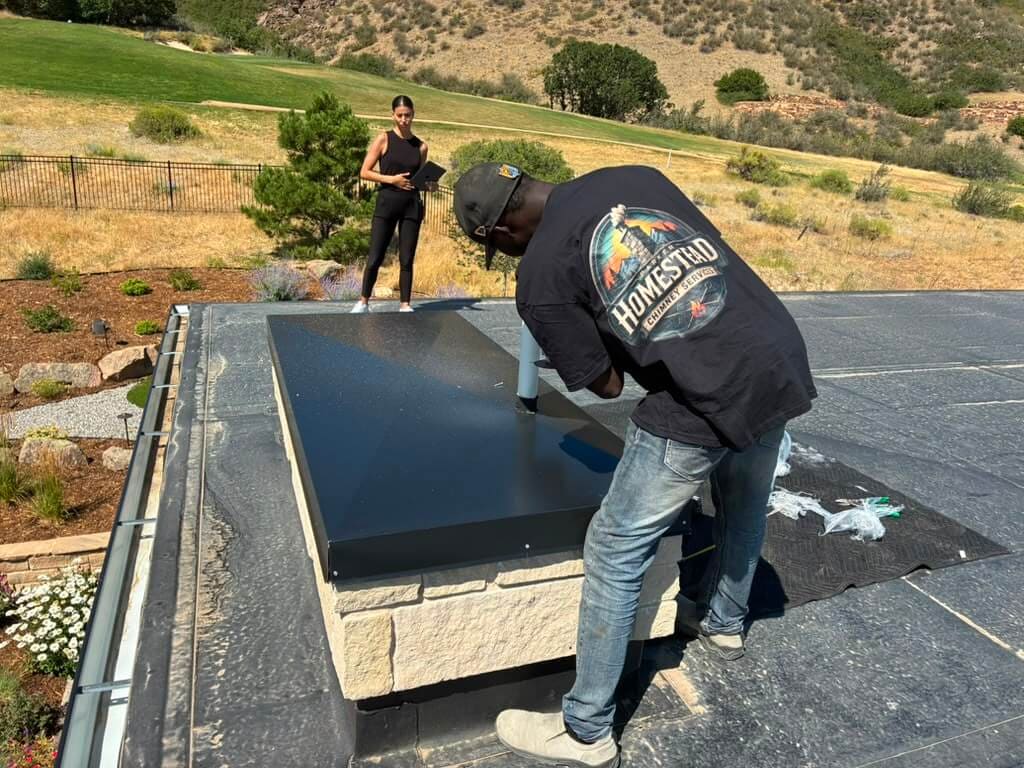
The storm comes through, the roofer comes out, the shingles get counted, and somebody hands you an estimate. Almost nobody looks at the chimney. It is the tallest thing on your house, it sticks up into the weather with nothing above it, and the metal on top of it is thinner than anything else on the roof.
If you are sorting out a chimney hail damage insurance claim in Parker, or just trying to work out whether you have one at all, the chimney top is the part that gets skipped on the first pass and the part most likely to leak later. A dented chase cover does not drip on your ceiling the week of the storm. It waits for winter.
Below is what Front Range hail actually does to a chimney, how to look at yours from the ground without climbing a thing, and how the claim side works in Colorado. Some of this will talk you out of filing. That is fine by us.
What a Front Range hailstorm does to the top of a chimney
What matters is how hard the stone hits, and that climbs fast as the stones get bigger. The table below comes from impact figures published by the National Bureau of Standards in 1969, tabulated by Haag Engineering in a paper for the American Meteorological Society.
| Hailstone diameter | Approximate fall speed | Approximate impact energy |
|---|---|---|
| 1.00 in (quarter) | about 50 mph | under 1 ft-lb |
| 1.25 in | about 56 mph | about 4 ft-lb |
| 1.50 in | about 61 mph | about 8 ft-lb |
| 1.75 in (golf ball) | about 66 mph | about 14 ft-lb |
| 2.00 in | about 72 mph | about 22 ft-lb |
| 2.50 in | about 80 mph | about 53 ft-lb |
A two inch stone carries more than twenty times the punch of a one inch stone. That is why one storm strips a neighborhood and another one just makes noise. For scale on what falls here: NOAA's storm reports for Douglas County from 2015 through 2025 include 164 logged hail reports, the largest 2.50 inches at Castle Rock on June 8, 2019. Thirty-six of those reports were logged at or near Parker, the largest 2.00 inches on July 4, 2019.
The chase cover
If your chimney is a framed chase with siding or stucco rather than brick all the way up, the flat metal lid on top is the chase cover, and it is the most vulnerable piece of metal on your house. It is unsupported sheet metal lying flat under the sky. Aluminum and galvanized covers dent. Dents that flatten the slope let water stand, and standing water finds the seams and the flue collar. Stainless holds shape better.
The cap and the spark screen
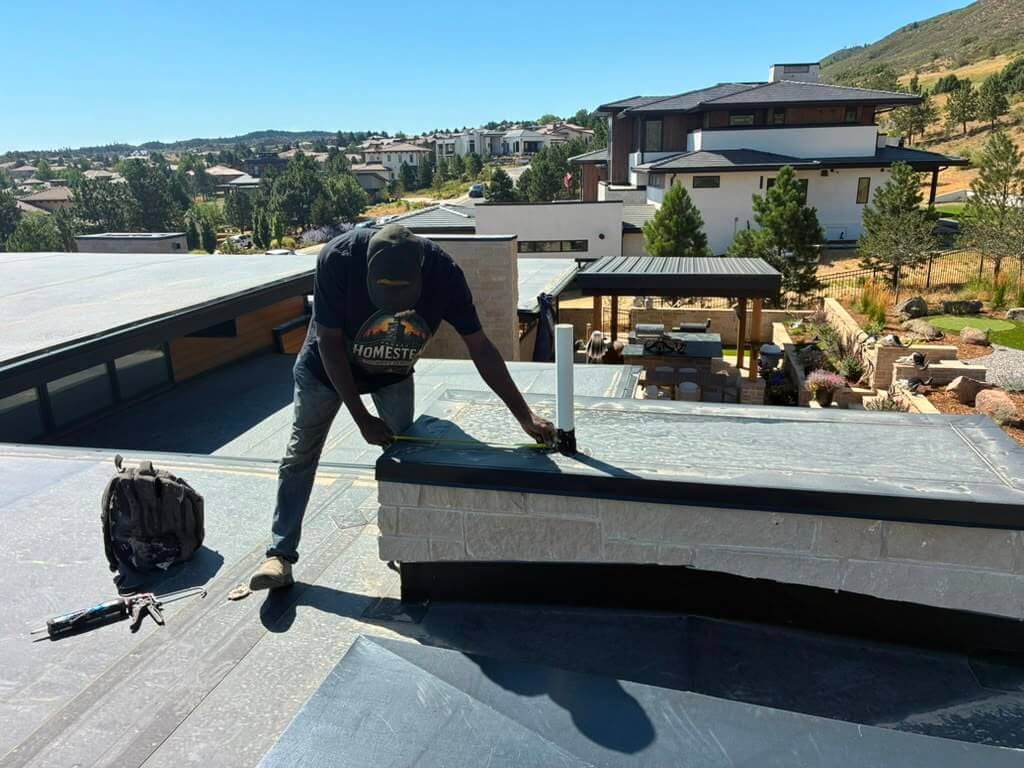
The cap sits highest of anything. Its lid takes direct hits, and the spark screen underneath is light mesh that bends, tears at the corners, or pushes in far enough to touch the flue. A crushed screen restricts draft, which matters more here than most places, because a chimney at this elevation is already working with less pull. A cap knocked off square lets rain straight down the flue.
The crown
On a masonry chimney the crown is the sloped slab across the top that throws water clear of the brick. A proper one is Portland cement based, cast with an overhang past the brick on every side, sloped to drain, with the flue liner standing above it. Most crowns, per the training material published by InterNACHI and the Chimney Safety Institute of America, are not built that way. They are common mortar mix, thin, flush to the edge, and already carrying hairline cracks before any storm arrives. Hail chips the wash edge and opens what was already there.
Flashing and the roof around the chimney
Flashing is the metal that ties the chimney into the roof, and its whole job, as the Insurance Institute for Business and Home Safety puts it, is to move water away from the penetration. IBHS notes that as flashing moves through expansion and contraction it loosens its fasteners and works free of its cleats and clips, and that is when water gets under. A hail strike that distorts a flashing leg does the same job faster. Look also at the shingles in the two or three feet around the chimney base. That is a low, wet, hard-working piece of roof, and granule loss there matters more than it does out in the field.
A dent by itself is not automatically damage
This part gets oversold constantly, so here is the honest version. Forensic engineers define hail damage to roofing as a loss of water-shedding ability or a real shortening of service life. Haag's ice ball testing found that aluminum panels struck by stones in the 1.00 to 1.25 inch range dented, but the dents were cosmetic. InterNACHI says the same thing about metal panel roofing: hail dents it and seldom breaks it.
The argument that holds up is functional, not cosmetic. Distorted seams that no longer seal. A flattened cover that ponds. A perforation. A screen crushed into the flue. Published hail thresholds cover roof coverings only. The oldest organic mat three tab shingles start taking damage at 1.00 inch, but the fiberglass mat shingles actually on Parker roofs needed 1.25 inch stones in the same testing. We have found no published threshold for chase covers, caps, crowns or counterflashing. Chimney top metal is thinner and less supported than a shingle over a deck, so it is reasonable to look at it whenever the roof gets looked at. That is our inference from the roofing data, and we would rather say so than dress it up as research.
Hail, freeze and thaw, and the leak that shows up in February
Here is the sequence that catches Parker homeowners. Hail opens something small on top in June. Nothing leaks. Water starts getting in where it did not before, a little at a time. At about 5,900 feet we run through freeze and thaw cycles all winter, and the training material from CSIA and InterNACHI documents that chain clearly: water entry accelerates joint failure, soaks brick, and pops the faces off it. By February there is a stain on the ceiling. By then the storm is eight months gone and so, often, is the notice window in the policy.
This is also where claims get denied, because the wear and tear exclusion is the easiest argument an adjuster has in this state. Freeze and thaw damage genuinely is everywhere here, and it genuinely is not covered. The evidence that separates the two looks like this.
| What you are looking at | Reads as storm impact | Reads as age and freeze-thaw |
|---|---|---|
| Crack and chip edges | Fresh, sharp, lighter than the weathered surface around them | Rounded, dirty, weathered the same color all the way through |
| Pattern across the chimney | Concentrated on one or two faces, consistent with the storm's direction | Even on all sides, worst where water sits and drains |
| Metal surfaces | Dents with bright or scuffed centers where oxidation was knocked off | Rust blooming at seams and fasteners with no deformation |
| Brick and mortar | Chips knocked off edges and the crown wash | Brick faces flaking off in layers, joints washed hollow |
| When it appeared | In the days after a dated storm | Gradually, worse each spring |
One more piece of timing worth knowing. Haag's field guidance notes that hail spatter marks, the scuffed spots on oxidized metal that show stone size and direction of fall, fade off within a year or two, while the dents stay. The damage outlasts the proof of what caused it. That is the real reason to look promptly, and it is a better reason than anybody's countdown clock.
A ground level check you can run without a ladder
Stay off the roof. That is not us being precious about the work; walking a hail-struck roof adds damage, and the Rocky Mountain Insurance Association, the insurance trade group here, tells homeowners to let only the adjuster and their chosen contractor up there. Everything below can be done from the yard.
- Walk the yard first. Stripped leaves off the shrubs, dented patio furniture, torn screens, dinged downspouts, bent fins on the air conditioner. RMIA treats dented soft aluminum roof vents and patio covers as a signal to get the roof inspected. Your chase cover is thinner soft metal than most of those, so we read it the same way. That analogy is ours, not theirs.
- Get binoculars on the chimney top from two sides of the house. You are looking for a cap sitting crooked, a lid with a pocked or wavy surface, a screen pushed in, or a chase cover that has lost its crown and gone flat or dished.
- Check where the downspouts let out. A pile of shingle granules after a storm tells you the roof surface took a beating, and the chimney sits in the middle of it.
- Look at the chase siding or stucco for cracked, punched or bruised spots, especially on the storm-facing side.
- Go inside. Look at the ceiling and wall where the chimney passes through, at the drywall corners of the chase, and in the closet or attic space alongside it if you can get eyes on it safely.
- Open the fireplace and look up with a flashlight. Damp masonry, rust on the damper, water lines inside the smoke chamber, or a musty smell after rain all say water is getting in from above.
None of that proves hail. It tells you whether the chimney is worth a proper look from up top, which is the part to hand to somebody with a ladder and a harness. If you like doing your own maintenance, we keep some of the safe-from-the-ground work written up on our DIY page.
What to photograph, and why the storm date matters
A claim is a documentation exercise. The Division of Insurance tells homeowners to photograph damage, report it promptly, and keep water out in the meantime. Photographs taken from the ground still count, and they beat a description every time.
- Put a scale object in the frame. A quarter, a tape measure, a ruler. Size is the whole argument on a hail claim, and 1.00 inch is the National Weather Service severe threshold.
- Shoot wide, then close. One frame that shows which side of the house you are on, then the detail. An adjuster needs to know what slope and what elevation they are looking at.
- Nail down the date. Storms are dated events and your policy cares which one. NOAA's Storm Events Database is public and searchable by county and date, and it will show whether hail was reported in Douglas County the day you think it was.
- Photograph the interior too, with the date, even if the stain is small. That is your evidence later that the leak started after the storm and not before it.
- Keep hail stones if you have them. Photograph one next to a coin before it melts.
We can climb up, look at every joint and seam, and hand you a written report with dated photographs and honest measurements in it. What your policy owes you is your adjuster's call and your policy's call, not ours. We would rather do the part we are actually good at and let your adjuster do theirs.
- The Homestead team, Parker Homestead Chimney
How a homeowners claim works in Colorado
Sudden damage is one thing, upkeep is another
On most policies here the dwelling itself is written so that everything is covered except what the policy names as excluded, and wind and hail are ordinarily covered perils. Colorado carriers increasingly carve the roof out for separate treatment, though, so the general rule is where you start reading, not where you stop. What is not covered is the passage of time. As the National Association of Insurance Commissioners puts it in its consumer guide, a homeowners policy "isn't a maintenance contract." The line the carrier draws is between a sudden accidental event and deterioration you were supposed to keep up with. No Colorado rule names chimney caps, chase covers or crowns specifically. Your chimney is judged by that same general test.
Whether you get replacement cost or depreciated value
Two settlement methods, and the difference is large. Replacement cost pays to repair or replace without subtracting for age. Actual cash value pays the depreciated amount. Here is the arithmetic, and it is ours rather than the state's. Say a fifteen thousand dollar roof replacement, a one thousand dollar deductible, and ten years of depreciation at a thousand a year. The replacement cost policyholder collects fourteen thousand. The actual cash value policyholder collects four thousand. The Division of Insurance explains the two settlement methods plainly, and its definitions are worth reading alongside your own declarations page. The DOI also warns that some policies pay actual cash value on the roof while paying replacement cost on the rest of the house. Read that endorsement before you need it.
Under a replacement cost policy the first check is often the depreciated amount, with the rest, the recoverable depreciation, released once you show the work was done. There is a time limit on that, set by your policy, commonly somewhere from six months to a year.
The wind and hail deductible usually decides it
Colorado homeowners policies commonly carry a separate wind and hail deductible written as a percentage of your dwelling coverage rather than a flat dollar figure. The Division of Insurance names 1, 2 and 5 percent as typical, and says plainly that if the damage estimate lands below the deductible, no payment is issued. The Insurance Information Institute uses this arithmetic as its example: a home insured for one hundred thousand dollars with a 2 percent deductible has two thousand dollars taken off any claim payment. Scale that to a Parker dwelling limit and the number stops being abstract. Two percent of six hundred thousand is twelve thousand dollars, and that is your money before the carrier pays anything. Run the multiplication on your own declarations page before you pick up the phone.
Here is the honest consequence. Chimney top work by itself is frequently smaller than a percentage wind and hail deductible, which means filing a chimney-only claim can produce a claim on your record and no money at all. The same work bundled into a legitimate roof and chimney storm claim is a completely different conversation. We will tell you which one you appear to be in, and if it is the first one we will quote you the work and you can just have it done.
Why the chimney gets left off, and how it gets added
Adjusters scope roofs by walking field slopes and counting test squares. Chase covers, caps, crowns and counterflashing are separate line items and they are easy to leave off, particularly after a big storm when the carrier is working through hundreds of properties in a week. Being left off the first estimate is not a denial.
The Division of Insurance says outright that the first estimate is not always the final one, that additional damage often turns up once work begins, and that you should get that information to your insurer so it can review and issue a supplement before repairs continue. The DOI also tells homeowners to get several contractor quotes rather than accept a first offer they disagree with. We would go one step further, and this part is our advice rather than the state's: have the itemized bid in hand before the adjuster arrives, and be there in person to walk them through what you have found. Your insurer is not obligated to adopt a contractor's estimate, but a dated, itemized, photographed chimney report is a much harder thing to leave off a scope than a phone call is.
Deadlines, said plainly
There is no Colorado statute giving you a set number of months to report a hail claim, whatever the door-knocker tells you. Your reporting window comes from your own policy's notice provision, and one year for wind or hail loss is a common one. Report as soon as you know. In 2024 the Colorado Supreme Court held that an insurer cannot treat a late report as an automatic bar unless it can show the delay actually prejudiced it, but read that carefully: it is case law, not permission to wait, and the court looks first at whether your delay was reasonable. Sit on known damage and you can still lose.
Two other clocks. Colorado's claim-handling regulation sets a sixty-day standard for an insurer to decide or pay once it holds a valid and complete claim, with written status updates every thirty days after that while an investigation continues. That clock starts at a complete claim, not at the storm, a genuine dispute pauses it, and carriers can ask the Commissioner for relief after a mass hail event. Separately, suing an insurer runs on its own limits, generally three years for contract and two for bad faith tort, with the statutory bad faith claims still unsettled on that point. When those start depends on the facts, so a deadline question belongs with a Colorado attorney, not with your chimney sweep. The Division of Insurance runs a free consumer line at 303-894-7490 and it is a genuinely neutral place to ask.
The knock on the door after a Parker hailstorm
Crews follow hail. Some are good, plenty are not, and the Division of Insurance advises being careful with anyone who reaches you by cold knock or cold call: check references, work with Colorado-based contractors where you can, and get everything in writing. The state's roofing statute also gives you a written contract with the scope, cost and the contractor's insurer named, and a seventy-two hour right to cancel.
On deductibles, be direct with anyone who raises it. Colorado law forbids a residential roofing contractor from advertising or promising to pay, waive or rebate your insurance deductible, and if one does it, the insurer is not obliged to consider that contractor's estimate at all. Beyond roofing specifically, padding an estimate so the deductible disappears is insurance fraud under Colorado law, a felony, and it exposes the homeowner as well as the contractor. We will not do it, and neither should anyone standing on your porch. If someone offers, that is your answer about the rest of their work.
Repair that makes the next storm uneventful
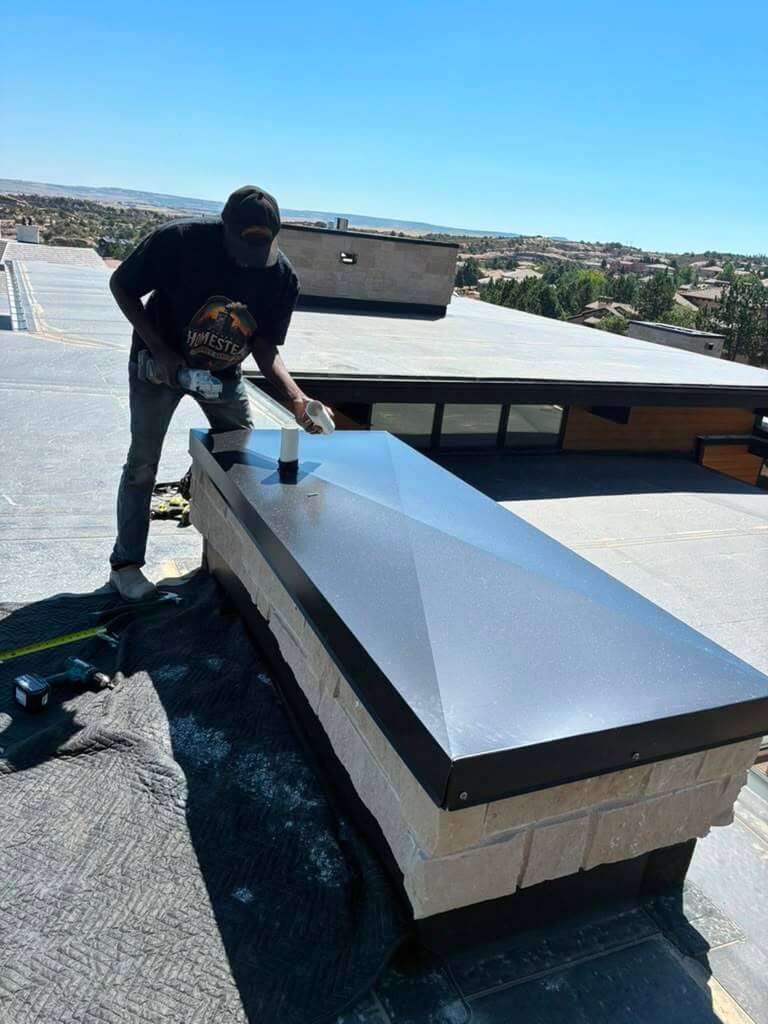
The fixes up top are not exotic. A chase cover cut and folded to the actual dimensions of your chase, with real slope, a proper drip edge standing off the siding, and cross breaks so it cannot pond. A cap that clamps square to the flue with a screen that holds its shape. A crown that overhangs the brick on every side, is sloped to drain, and lets the flue liner stand proud of it. Counterflashing cut into the masonry and sealed rather than smeared over. That is ordinary chimney work. Done right once, the next hail season is just noise on the roof.
On timing: Colorado's damaging hail season runs roughly from mid April to mid September, and NOAA's Douglas County reports mostly bear that out, with June alone accounting for close to four in ten logged reports and May through July carrying about eight in ten. The county still throws the occasional outlier, including a late October round in 2025 that put stones down in Parker. What the record does not show is a single hail report from November through March in those eleven years. So look in summer, right after the storm, while the spatter evidence is still readable and the roof is still dry enough to work on. October is when people call us, and October is late. If your chimney has not been looked at since the last hail season, get ahead of the next one.
Frequently Asked Questions
Does homeowners insurance cover chimney hail damage?
It may, and it commonly does when the damage is sudden, is tied to a dated storm, and is functional rather than cosmetic. It is frequently denied when the carrier reads the condition as wear, age or freeze and thaw deterioration, which is an easy argument to make in Colorado. Coverage depends on your specific policy, your deductible and the evidence, so nobody can promise you an outcome in advance. What helps is a dated, photographed, itemized report of what is actually wrong.
How can I tell if my chimney has hail damage?
From the ground, with binoculars, look for a crooked or pocked cap, a crushed spark screen, and a chase cover that has gone flat or dished instead of holding its slope. Then check the yard for the same storm signature on other soft metal, downspouts, screens, air conditioner fins, patio covers. Inside, look for fresh stains near the chimney and rust or damp inside the firebox. Confirmation takes a look from up top, which is not a homeowner job.
Can hail damage a chimney cap or a chase cover?
Yes, and they are the most exposed metal on the house. Published hail damage thresholds cover roof coverings, not chimney components, so treat those roof numbers as a starting point rather than a rule for chimney metal. The point that matters to a claim is not the dent count but whether the piece still sheds water: distorted seams, ponding on a flattened cover, a perforation, or a screen pushed into the flue.
How long do I have to file a hail damage claim in Colorado?
There is no Colorado statute setting a filing deadline, despite how often you will hear one quoted. The deadline that binds you is your own policy's notice provision, and one year for wind or hail loss is common language. Report promptly regardless. A 2024 Colorado Supreme Court decision means a late report is not automatically fatal if the insurer cannot show it was prejudiced, but that is not a reason to wait.
What is a wind and hail deductible?
It is a separate deductible that applies only to wind and hail losses, and in Colorado it is often written as a percentage of your dwelling coverage rather than a flat amount. The Division of Insurance names 1, 2 and 5 percent as typical figures. If your damage estimate comes in under that number, the carrier issues no payment. Look up your dwelling limit and do the multiplication before you decide whether to file.
My roof claim was approved but the chimney was left off. Can it still be added?
Often, yes, through a supplement. The Division of Insurance states that the first estimate is not always the final one and that you should send your insurer any additional damage found so it can review and supplement the claim before repairs continue. What makes that go smoothly is a written, itemized chimney report with dated photographs and clear locations. You hand that to your adjuster; the decision stays with the carrier.
Have a look before winter does the deciding
The chimney is the part of the roof nobody checks and the part that quietly turns a June storm into a February ceiling stain. You can do most of the looking from your own yard in ten minutes. The rest of it, the part with the ladder, is what we are for, in the Parker neighborhoods we work in and nowhere else.
We come look for free, and you get what we found in writing whether or not there is a claim in it. Our pricing page covers how a quote comes together, and there is more chimney reading on the blog. Call the shop at (720) 222-4772 and we will set a time. The office sits at 9235 Crown Crest Blvd, Ste 120 in Parker. If the answer is that your chimney came through the storm fine, we will happily tell you that and be on our way.