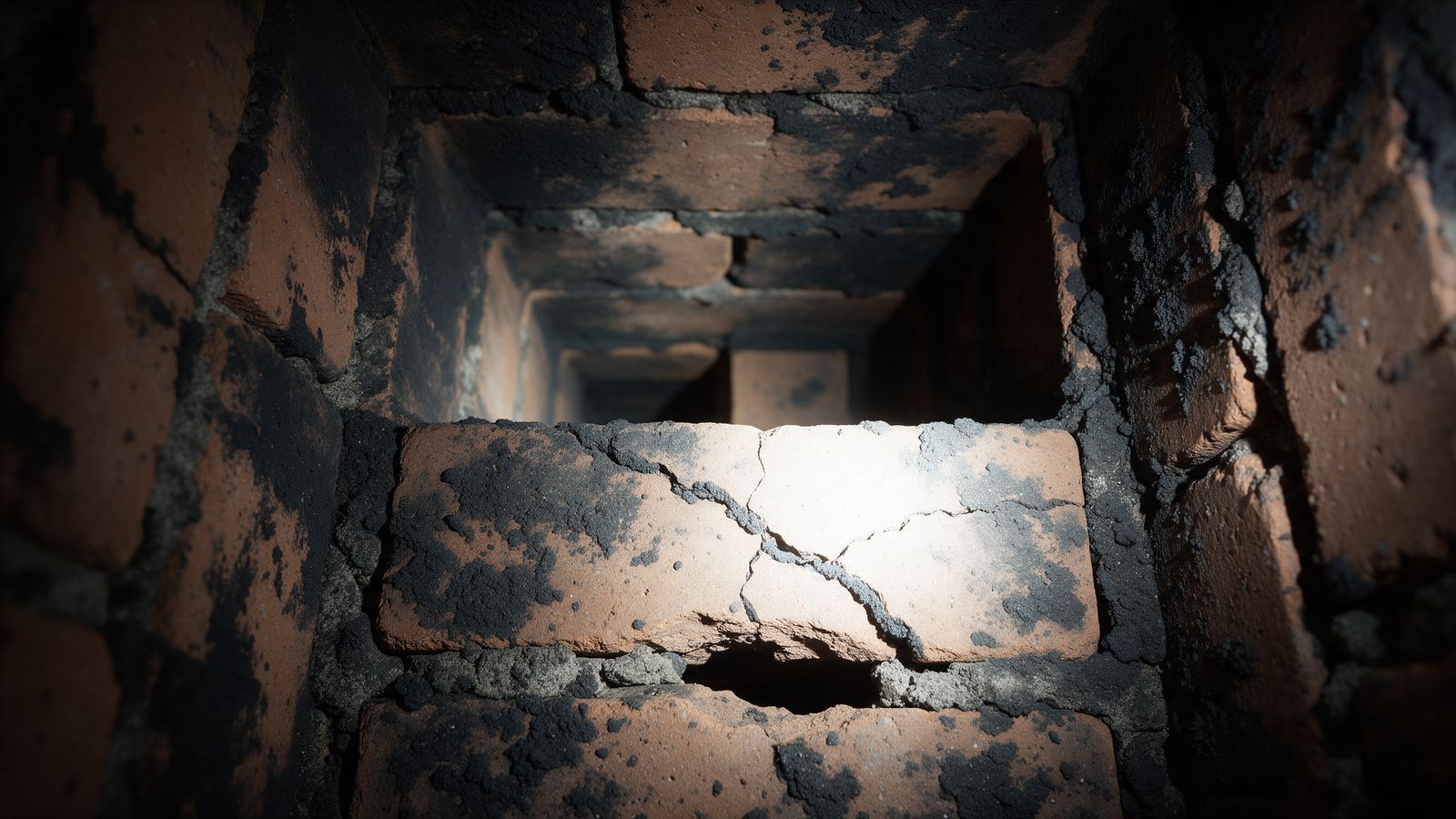
Defective flue tiles should be evaluated before the fireplace returns to use. Cracks, missing pieces and open joints can affect the chimney's ability to contain heat and combustion products. The appropriate repair depends on the extent of damage, access, appliance requirements and surrounding chimney condition. A surface patch, tile replacement and complete relining are different solutions for different circumstances.
For a Parker homeowner, the first task is to understand the finding. Ask where the defect is located, how it was documented and what remains unknown. An estimate should explain why the proposed method fits that condition. The word cracked does not describe the full scope, and the word old does not establish a repair method.
Understand the role of the clay liner
Clay flue tiles form an internal passage in many masonry chimneys. Their joints and surrounding construction are part of the venting system. The liner is not the same as the exterior brick stack, and repairs to one do not automatically correct defects in the other.[1]
A tile can be damaged by heat, movement, impact or deterioration. Missing mortar at joints can create another concern even when the individual tile faces appear intact. The inspection should assess the complete accessible passage rather than focus only on the most visible crack near the top.
The connected appliance matters. A masonry fireplace, wood stove and gas appliance impose different venting conditions. Before selecting a repair, identify the fuel, appliance model and intended future use. A method that preserves the current opening may not be suitable after a planned conversion.
Read inspection images with context
Video inspection helps reveal internal surfaces that cannot be seen from the hearth. Ask for images labeled by location and component. A close up should be accompanied by enough context to show whether the issue is a tile face, joint, connector or another surface.
Visibility has limits. Deposits can obscure defects, and a camera cannot show every concealed clearance or hidden construction detail. The report should distinguish observed damage from conditions that require further investigation. If cleaning is necessary before assessment, document relevant material before it is removed.
CSIA's post chimney fire guidance emphasizes evaluation of liner integrity and joints before reuse.[2] If a fire or other significant event is suspected, the inspection scope should reflect that history. A routine glance from above or below may not answer the relevant questions.
“The repair method should follow the documented extent of liner damage and the appliance the chimney will serve.”
Separate localized defects from system wide problems
One accessible damaged tile near the termination presents a different task from failures distributed through a tall chimney. Location affects access, removal and the ability to form sound joints. Ask whether the proposed localized repair can be completed and verified without leaving other defects untreated.
Widespread cracking, missing sections or repeated joint failures may make a continuous listed liner a more appropriate option. That decision still needs a sizing and installation basis. A new liner must fit the route and comply with its listing and the appliance requirements; it is not simply a tube selected by convenience.
Structural movement can change the priority. If the chimney is leaning, separating or otherwise unstable, repair of the surrounding structure may need to precede lining work. A new passage does not restore support or eliminate a falling masonry hazard.
Compare repair categories carefully
| Approach | Potential application | Key verification |
|---|---|---|
| Selective tile replacement | Defined accessible damage | Sound joints and surrounding support |
| Approved joint or surface repair | Conditions permitted by the repair system | Substrate suitability and installation limits |
| Listed metal relining | Compatible appliance and chimney route | Sizing, insulation and complete connections |
| Broader rebuilding | Structural or extensive construction failure | Design, support and code requirements |
The table is not a recommendation that every method is available for every chimney. Proprietary repair products have specific instructions and limitations. Ask for those documents and the reason the condition qualifies, especially when a coating is proposed for a substantial crack or missing material.
Evaluate relining as a complete installation
UL 1777 addresses listed chimney lining systems within its stated scope.[3] Product identification should include more than the word stainless. Material, dimensions, insulation and connection details must be suitable for the appliance and installation. Request the exact product and written sizing basis.
Existing tile may remain in some approved installations; other arrangements may require removal or another method. Determine that early. Removal changes labor, debris control and the available internal space. The contract should explain how the room, roof and surrounding construction will be protected.
The top and bottom connections are equally important. The appliance connector, cleanout arrangement, support and termination should be described. A liner that is correct in the middle but poorly connected at either end is not a complete repair. Photographs should document those details before they become difficult to inspect.
Address the cause alongside the damage
If moisture contributed to deterioration, inspect the cap, crown, flashing and masonry. If a chimney fire occurred, evaluate the operating conditions and deposits that preceded it. If movement is present, determine whether structural expertise is needed. Repeating the same repair without addressing the cause can create another failure.
Do not assume that a new liner will resolve every draft complaint. House pressure, appliance operation, chimney geometry and fuel quality may still matter. The proposal should state the expected result and any additional investigation needed when symptoms involve more than visible tile damage.
Keep repair materials compatible with the application. Household caulk and general purpose mortar do not become suitable flue repair products because they can be pushed into a gap. High temperature exposure, combustion gases and installation access require a system intended for that work.
Confirm permits and property jurisdiction
The Town of Parker publishes its adopted codes and permit guidance.[4] Check the current requirements for the actual address and scope. A postal address using Parker can fall under another authority, and permit responsibility should be clear before work begins.
Ask who will submit documents, schedule inspections and retain approvals. If gas, electrical or structural work is involved, identify the responsible trades. Do not allow finished surfaces to close inspection access before the required checks are complete.
The homeowner should receive a written scope that names both the repair and its limits. If surrounding masonry or roof work is excluded, say so explicitly. Clear boundaries make it easier to coordinate the complete job and compare estimates fairly.
Request this documentation before approving the contract.
Follow a documented repair sequence
- Keep the affected fireplace or appliance out of service.
- Identify the appliance and record the damage with location information.
- Clean or investigate further where visibility is insufficient.
- Compare suitable repair methods and their limitations.
- Confirm permits, product instructions and related structural work.
- Complete the installation and verify accessible connections and surfaces.
- Record the conditions for return to service and future maintenance.
Verification should answer whether the defined defect was addressed and whether any unresolved condition remains. A photograph of new material alone is not enough. The report should connect the finished work to the original findings and explain any area that could not be confirmed.
Keep the original inspection images after completion. Paired before and after views help explain which defects were corrected and which surrounding components were retained. Label their locations and dates rather than saving an unlabeled camera folder. If the property changes hands, those records give the next owner a clearer understanding of the liner installation and reduce confusion between documented repair work and an assumption that the entire chimney was rebuilt.
Prepare questions that matter
Why is this method appropriate for this defect? What other damage was checked? Does the selected product permit this appliance and fuel? What insulation or clearance assumptions are being used? How will the result be documented? These questions test the reasoning without requiring the homeowner to become a chimney designer.
Also ask what would change the estimate after work begins. Concealed damage, inaccessible offsets or unstable masonry can affect scope. A clear change process is more useful than a price that appears fixed only because important unknowns were never discussed.
Parker Homestead Chimney's lining and inspection pages provide the relevant starting points for a flue tile concern. Share the report, images, appliance information and any event history when requesting an assessment. The objective is a repair that suits the documented condition, with a clear record of why the chimney can return to its intended use.
Sources and further reading
- Chimney Safety Institute of America Homeowners Guide to Chimneys Fireplaces and Woodstoves
- CSIA What You Need to Know After a Chimney Fire
- UL Standards and Engagement UL 1777 Standard for Chimney Liners
- Town of Parker Building Codes
Sources accessed October 15 2026. Product manuals and applicable local requirements control specific installations.